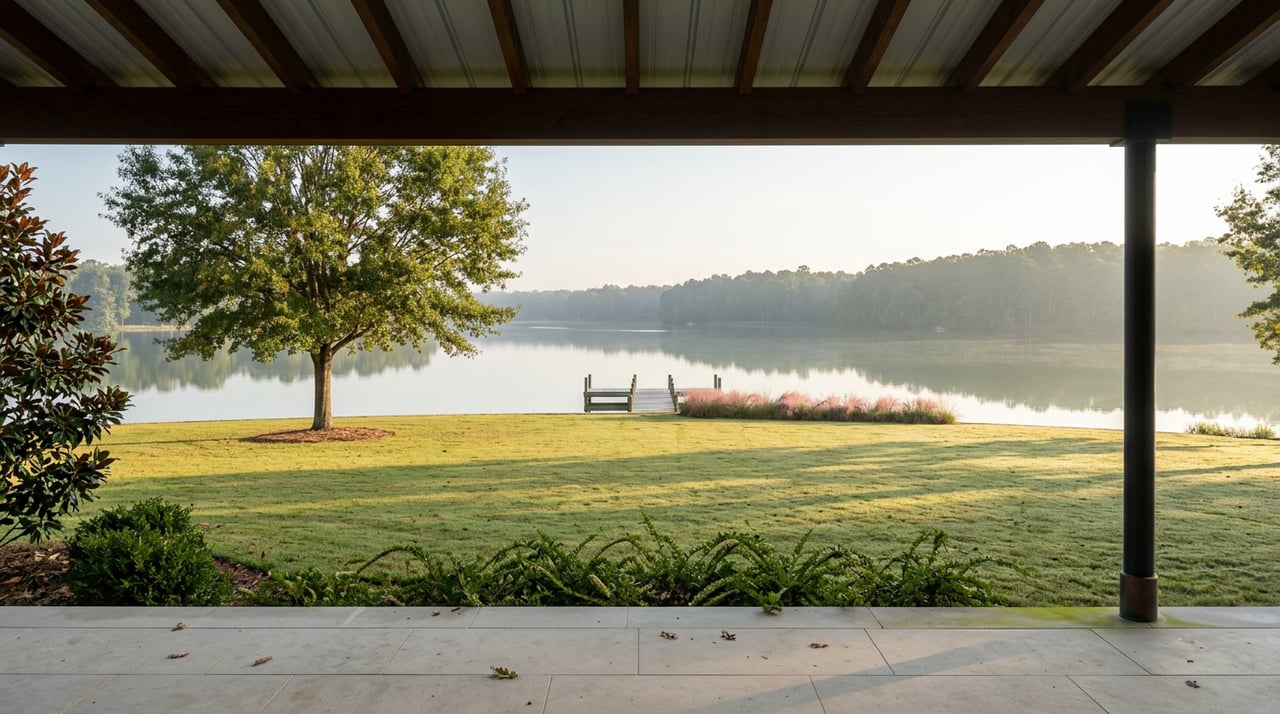
Lake Oconee Boathouse Rules: Eligibility, Permits, and What Buyers Should Check
September 24, 2026
September 24, 2026
Somewhere in the paperwork behind a Lake Oconee closing sits a page most buyers skim past: a shoreline permit number, a lease reference, a note in the survey about frontage. It rarely gets a second look until the new owner calls a builder about adding a boathouse and hears, for the first time, that the answer is no.
That answer traces back to a single Georgia Power rule that governs Lake Oconee differently than almost anywhere else in the company's lake system. It is worth understanding before treating two "waterfront" listings as the same kind of asset, because on this lake, they frequently aren't.
Georgia Power's shoreline management rules start from a blanket position: boathouses are not permitted on Lake Oconee. The only exception belongs to the original owner of a given parcel, or an heir who has kept the property in the family, and even then the structure has to meet the same specifications the company applies on neighboring Lake Sinclair. Everyone else with lake frontage gets a dock, not a boathouse, regardless of how much shoreline they hold or how much they are prepared to spend.
That single distinction quietly splits every "boathouse eligible" listing on the lake into two categories that look identical from the road.
The operative word in that rule is "original." Eligibility doesn't run with the land the way a view or a walking easement would. It runs with a specific ownership line.
Boathouse eligibility is the sharpest edge of a broader pattern on this lake. Dock rights are set by rules that predate any individual listing, and none of them show up in a search filter.
Whether a parcel is deeded outright or sits on a Georgia Power lease lot affects what paperwork buyers should review. That isn't a defect; it's a different set of rules to plan around.
Shoreline footage matters just as much. Lots platted before 2000 need at least 75 feet of straight-line shoreline to qualify for even a single-stall boathouse under the exception. Lots platted after 2000 need 100 feet. A lot that looks generous on a plat map can still fall short of either line.
Even where a dock or boathouse is fully permitted, the layout itself is fixed. Georgia Power allows a single boatslip configuration of 16 feet wide by 32 feet deep per private residence, with the main walkway held to 6 feet and the outer slip walkway to 4 feet. Georgia state law adds its own ceiling on top: no vessel longer than 30 feet 6 inches, and no houseboat with a galley, sleeping quarters, or marine toilet anywhere on the lake. Whatever the budget, the rule book sets the size, not the buyer.
Greene County's Board of Commissioners has kept approving those lots on a steady schedule. At its June 10, 2025 meeting, the board signed off on a preliminary plat for Forest Ridge, Sections I through V, creating 64 lots from 77.66 acres inside the Reynolds Lake Oconee planned unit development, approved a final plat for 12 lots at Village at Reynolds Landing, Section 3, and cleared 14 new lots for Harbor Club on Lake Oconee, Phase 2, Section D. By its November 18, 2025 meeting, the board had moved Forest Ridge, Section IV to a final plat covering 16 lots from 17.15 acres, approved 18 new lots at Hardin North, Section II, and signed off on 19 lots at Carthouse Commons, Phase I, also inside Harbor Club. Airabella at Lake Oconee has been working through its own phases since a Phase 2B preliminary plat, 49 lots from 18.50 acres, cleared the board in 2023.
Every one of those lots will eventually be sold to a first owner. A resale a few doors down, even a newer and larger house, inherits the frontage and the view but not the eligibility.
None of this shows up in a median price or a search filter marked "waterfront." Two homes on the same cove, priced within a few thousand dollars of each other, can represent genuinely different long-term assets, even when the dock in the listing photo looks the same. The paperwork behind it does not.
For a buyer weighing Lake Oconee against another part of the lake, or comparing a lot in Reynolds against one in Harbor Club or Cuscowilla, the sticker price is the easiest number to compare and the least useful one on its own. What is actually being purchased, ownership history, lease status, platted shoreline footage, and permit paperwork, is where the real difference lives.
Does every Lake Oconee waterfront home come with dock rights? No. A dock or boathouse requires its own Georgia Power shoreline permit, and eligibility depends on when the lot was platted, how much shoreline frontage it has, and, for a boathouse specifically, on the ownership history of that exact parcel.
How big a boat can actually dock there? Georgia law caps vessel length at 30 feet 6 inches on Lake Oconee, and houseboats with a galley, sleeping quarters, or marine toilet aren't permitted on the lake at all, regardless of dock size.
Is a Georgia Power lease lot something to avoid? Not necessarily. It is a different arrangement to review, including any applicable lease terms and permit paperwork. It's a detail to plan around, not a flaw in the home.
Lake Oconee rewards buyers who ask the second question, not just the first. If you're comparing waterfront listings and want a clear read on what's actually transferring with the deed, permit history, lease status, and all, Kimberly Waldron is glad to walk through it with you. Let's Connect.
This article is general information, not legal, tax or financial advice. Consult a qualified professional about your situation.
Stay up to date on the latest real estate trends.
Experience a thoughtful, client-first approach built on trust, clarity, and exceptional service. Whether you're buying, selling, or relocating, Kimberly is committed to helping you move forward with confidence.

Kimberly Waldron
3035 Peachtree Rd Ste 202 Atlanta, GA 30305